Convert
Evaluate AI tools with spend and share signals, not demos
A demo shows the happy path. Spend and share show what teams actually keep.
September 21, 2026
Evaluate AI tools with spend and share signals, not demos
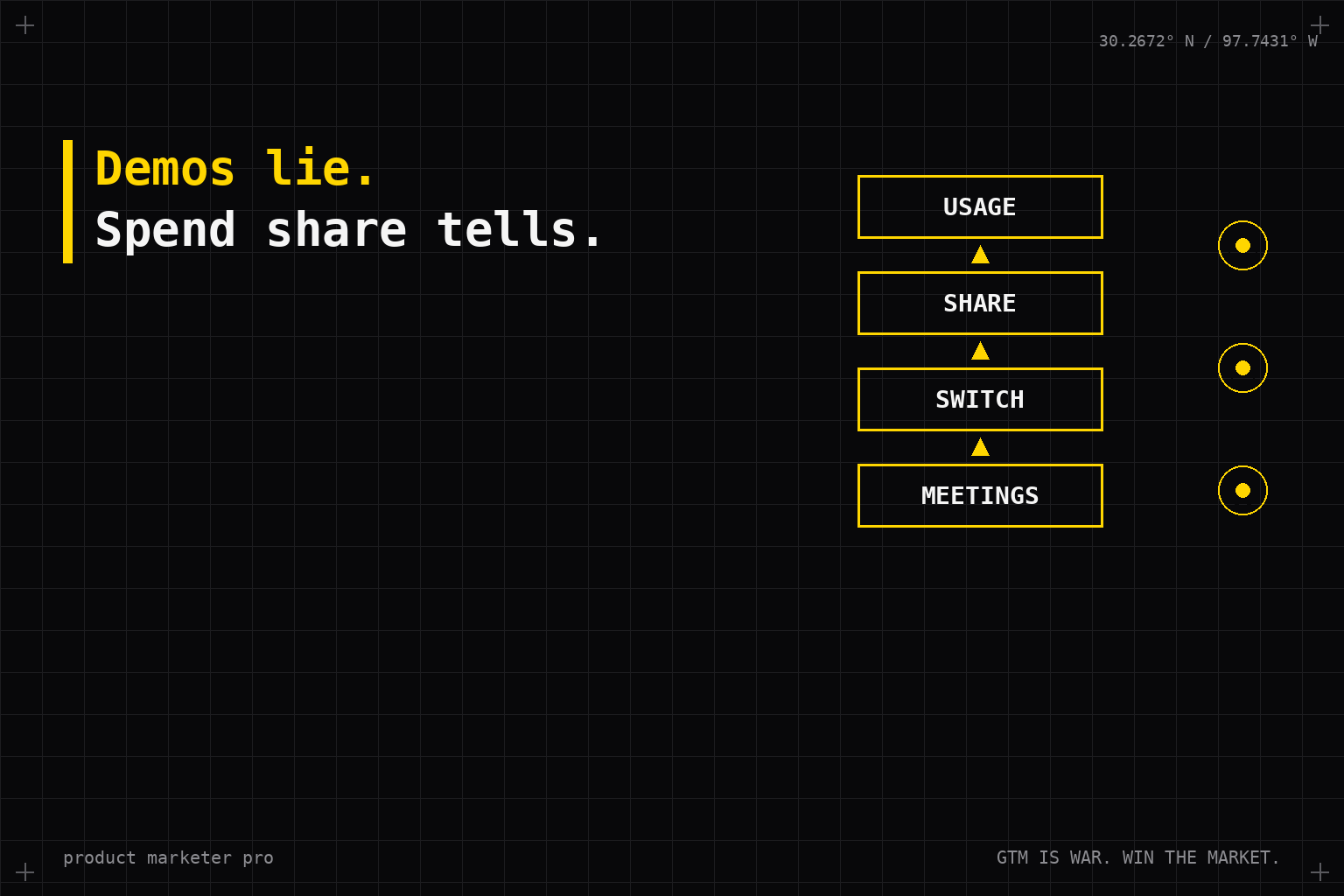
Demos lie politely. Spend and share tell the truth.
When enterprise cuts show one model family taking more wallet share than another (Ramp-cited Astra traction around 13% vs Claude around 8% in a recent enterprise split), that is not a feature shootout. That is a keep signal. GTM teams that pick tools from polished demos alone buy theater. Teams that read spend and share buy rails.
Ramp-style share (Astra ~13% vs Claude ~8% in one enterprise cut) is a buying signal. A polished demo is a sales asset. Confusing them is how Gartner 30%+ ghost piles grow.
Why do demos fail as the primary evaluation?
Because demos are designed to pass the grunt test for the seller, not for your workflow.
You see the happy path. You do not see prompt failure under real CRM dirt, permission mess, or the SDR who will ignore the tool in week three. Salesforce's roughly 27% quota hit rate already tells you most revenue stacks are broken. Adding another AI seat without a keep metric is more broken stack.
I ask for proof of continued use. Seat count after 90 days. Tasks completed without a human rewrite. Meetings booked when the tool is in the loop versus when it is not.
What are spend and share signals?
Spend is where the budget lands after the pilot. Share is how much of a team's AI or GTM work that tool owns relative to alternatives.
Enterprise buyers already do this for models. GTM should do it for outbound agents, enrichment, de-anon, and content ops tools. Examples only: PostHog for product behavior, Clay for enrichment, RB2B or Vector for site identity, Factors.ai for account paths, G2 for category comparison. None of those matter if your team abandons them after the launch Slack thread.
Spend without share is a tax. Share without outcomes is a hobby.
How should GTM teams score AI tools?
Use a four-row scorecard. Keep it ugly and honest.
- Job: One sentence on the meeting or pipeline job. Not AI SDR. Book qualified meetings from signal-matched accounts.
- Keep: 30/60/90 day active use by the people who touch pipeline.
- Share: Percent of that job the tool owns vs spreadsheets and rival apps.
- Receipt: Meetings, reply rate lift vs Gong's ~3.4% cold email floor, or cycle impact vs Forrester's ~84-day backdrop. If you cannot name a receipt, you bought a demo.
If the vendor cannot talk about keep and share, they will talk about features until your calendar is empty.
What do I do when vendors only want to demo?
Ask for a two-week job pilot with your dirt, not their sandbox.
Bring one buying-window list. Require human review logs. Score first-touch quality: a note that could have gone to anyone fails. Measure meetings booked, not tokens used. Gartner still sees 30%+ of deals end in ghost or no-decision. Tools that inflate demo volume without raising signal quality feed that pile.
This isn't a vendor problem. This is an evaluation problem.
How does this fit Convert-stage work?
Convert is where the offer and system close. Tool choice is part of that system, not a side quest.
A marketing mechanism is the how. An AI tool is either a piece of that how or a costume. Conversion is a system. Seat logos on a slide are not a system.
Would you rather a tool that wins the demo bake-off, or a tool that still owns 40% of your outbound prep in month three?
I pick keep and share. Every time.
Adapt or fail. The invoice after the pilot is the real review.
FAQ
What is a spend/share signal for AI tools?
Spend is post-pilot budget. Share is how much of a real job the tool owns versus alternatives. Together they beat demo theater.
Should I ignore demos completely?
No. Use demos to check fit. Decide with keep, share, and pipeline receipts.
How does this relate to AI as operator?
AI as operator means the model works inside a job with rails and review. Demos without rails are toys.
What if my team loves the demo but usage dies?
Kill or cut scope. Preference without keep is not product-market fit for an internal tool.
Which metrics prove an AI GTM tool works?
Meetings from signal-matched sends, reply quality above spray floors, and active weekly use by the people who own pipeline. Not token charts.
Frequently asked questions
- What is a spend/share signal for AI tools?
- Spend is post-pilot budget. Share is how much of a real job the tool owns versus alternatives. Together they beat demo theater.
- Should I ignore demos completely?
- No. Use demos to check fit. Decide with keep, share, and pipeline receipts.
- How does this relate to AI as operator?
- AI as operator means the model works inside a job with rails and review. Demos without rails are toys.
- What if my team loves the demo but usage dies?
- Kill or cut scope. Preference without keep is not product-market fit for an internal tool.
- Which metrics prove an AI GTM tool works?
- Meetings from signal-matched sends, reply quality above spray floors, and active weekly use by the people who own pipeline. Not token charts.