Convert
You keep buying channels. You never named what they want.
You keep buying channels. You never named what they want. 28,000 organic views. 4 website visits. Zero sales. That was not a channel failure. That was a desire failure dressed up as distribution.
September 3, 2026
You keep buying channels. You never named what they want.
You keep buying channels. You never named what they want.
28,000 organic views. 4 website visits. Zero sales.
That was not a channel failure. That was a desire failure dressed up as distribution.
I keep watching founders do the same move. New Meta budget. New Claude sequence. New "AI content system." New landing page that looks like someone else's. The stack gets louder. Pipeline stays soft. Then they blame LinkedIn, or the agency, or the model.
Inbound is dead if you treat it like a faith. Paid is expensive if the message is fog. AI is an operator, not a strategy. None of that fixes the part you skipped.
This isn't a traffic problem. This is a desire problem.
Ehrenberg-Bass and the LinkedIn B2B Institute keep pointing at the same ugly fact: about 95% of your ICP is not in market right now. You still write like the whole list is ready to buy.
So basically you are optimizing ads for people who are not shopping, and wondering why CAC keeps climbing.
A founder will say they need more pipeline. Or more content. Or a better CRM.
Those are purchase labels.
Underneath, it is usually uglier and more honest. Tired of losing mindshare to a weaker competitor. Sick of explaining the product on every call. Book of business still mostly referrals. Afraid the category will get defined without them. Want meetings that convert, not theater that fills the calendar.
If you sell "content strategy," you sound like every other vendor with a calendar. If you name the desire, they stop scrolling.
Would you rather sound smart, or be understood?
Most SaaS copy fails the first five seconds.
"AI-native revenue orchestration for complex buying committees."
Nobody knows what changed for them after that sentence.
Try this instead:
"Stop wasting demos on accounts that are never going to buy."
Or:
"Get meetings with people who already raised their hand, not strangers you hope will."
Same product. Different job. One asks the buyer to decode you. The other names a pain they already feel.
I do not care how clever the line is. I care whether a stranger can tell what they get, what gets better, what stops hurting, and why you.
If they have to translate you, they already left.
Raise the contrast. Then make the path believable.
People do not buy because you raised ad spend. They buy when the gap between now and later feels expensive, and the path feels real.
Now: burning money on outbound that gets ignored. 27% of B2B reps hit quota (Salesforce). Cold email replies around 3.4%, cold call to meeting around 2.3% (Gong as cited). Cycle times stretching. Ghosts and no-decisions eating the forecast.
Later: a short list of accounts that are actually moving. A page that closes. A first touch that could not have gone to anyone else.
Distance: do they believe you can get them there. Can they see the steps. Does it feel built for someone like them, not a guru deck.
A naked promise fails that test.
"Grow faster with AI" is a slogan.
A mechanism is boring on purpose. Watch the site for companies that hit competitor G2 pages or your pricing. Enrich the people. Write a note that only fits that account. Book the meeting. Hand it to sales with context. That is a path. The buyer can argue with it. They can steal it. They can tell you why the old spray failed.
If you cannot say the how in plain steps, you do not have a positioning problem yet. You have fog.
Positioning is which desire you attach to
The same product can mean five different things.
More posts. More traffic. Authority in the category. Shorter cycle because they arrive warm. Protection while CAC rises and the feed fills with lookalikes.
For a founder who already shipped, "we help you post more" is weak. They do not wake up wanting twelve LinkedIn posts.
Stronger: we make the market understand why you are the obvious buy before the first sales call.
That ties the work to trust, acquisition, and revenue. They can see why it matters.
You cannot invent urgency for a problem they do not feel. You can show the cost of a problem they have been underpricing.
Channels are last for a reason
LinkedIn. Meta. Email. Webinars. Cold outbound. Partnerships. Events.
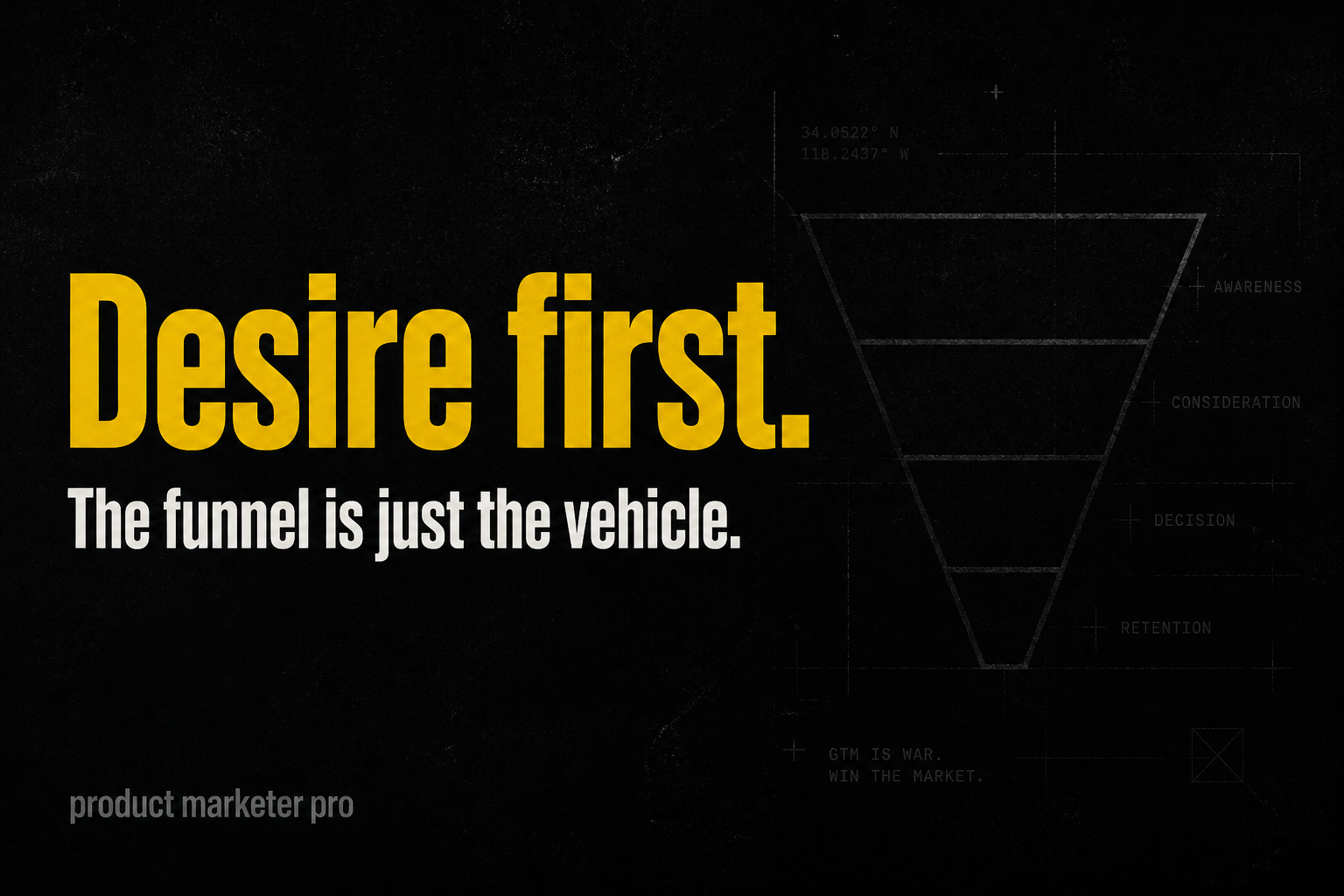
Those are vehicles.
A weak message does not get strong because you put it in a proven hook format. A confusing offer does not get clear because the landing page is pretty. An irrelevant promise does not get desirable because you raised spend.
The vehicle changes reach, cost, format, speed. It cannot repair a missing foundation.
That is why teams clone a funnel and still miss. They copied the page, the ads, the webinar shape. They missed the read of the buyer underneath. The visible campaign was built on an invisible judgment call.
DO NOT DO THIS.
I have thrown out a big chunk of my own playbook for this reason. Tools got better. The desire still had to be named first.
What I actually do before I touch a channel
I hate talking about problems without discussing solutions.
-
Who buys when it is urgent. Not "SaaS founder, Series A." What happened this week. What they are tired of. What scares them if nothing changes. What winning looks like in one sentence.
-
Dig past the purchase label. They want content. Why. Visibility. Why. Warm conversations. Why. Revenue stopped being predictable. Now you are close to money, status, control, or belonging. Stop earlier and you will write sludge.
-
Write the mechanism like a checklist. Why the old approach failed. What is different. Why that difference should work. What they have to do. No fog words.
-
One line each: painful now, desired later, cost of staying, mechanism, proof. Cut until a stranger gets it without a glossary.
-
Then pick the vehicle. Where they already pay attention while thinking about that problem. Not where marketers are performing this week.
Signals, Convert, Grow runs in that order for a reason. Signals finds who is in a window. Convert is who / why / how once you have one. Grow is spend after the page and the message can close.
Name the desire. Make the path credible. Then pay to carry it.
FAQ
Why did my content get views and zero pipeline?
Because attention is not desire. 28,000 views with 4 visits and zero sales is the receipt. The post entertained people who were never going to buy, or it never named a change they already wanted. Views without a desire and a path are vanity.
What is the difference between a purchase and a desire?
The purchase is the label in the meeting. CRM. Content system. Demo. The desire is the change: money, being chosen, less chaos, a book of business that is not luck. Market the desire. Sell the purchase as the how.
How do I know if my message is clear?
Read it to someone outside your company. If they cannot tell what they get, what improves, what pain leaves, and why you, rewrite. Jargon is you making them do the work.
What is a mechanism in GTM?
The concrete how. Steps. Why spray failed. What is different now. What the buyer must do. "Use AI to market the product you already built" only works when the how is visible. A promise without a mechanism is a slogan.
Should I pick LinkedIn or ads first?
Neither. Desire, contrast, and mechanism first. Then the vehicle where your buyer already pays attention. Channel-first is how you burn money on a message nobody needed.
How does this fit Signals, Convert, Grow?
Signals finds people in a buying window. Convert is clear who / why / how and a page that can close. Grow is paid once that works. Desire and mechanism live under Convert. Vehicles live under Grow. Do not flip it.
You keep buying channels. You never named what they want.
That's it.
Frequently asked questions
- Why did my content get views and zero pipeline?
- Because attention is not desire. 28,000 views with 4 visits and zero sales is the receipt. The post entertained people who were never going to buy, or it never named a change they already wanted. Views without a desire and a path are vanity.
- What is the difference between a purchase and a desire?
- The purchase is the label in the meeting. CRM. Content system. Demo. The desire is the change: money, being chosen, less chaos, a book of business that is not luck. Market the desire. Sell the purchase as the how.
- How do I know if my message is clear?
- Read it to someone outside your company. If they cannot tell what they get, what improves, what pain leaves, and why you, rewrite. Jargon is you making them do the work.
- What is a mechanism in GTM?
- The concrete how. Steps. Why spray failed. What is different now. What the buyer must do. "Use AI to market the product you already built" only works when the how is visible. A promise without a mechanism is a slogan.
- Should I pick LinkedIn or ads first?
- Neither. Desire, contrast, and mechanism first. Then the vehicle where your buyer already pays attention. Channel-first is how you burn money on a message nobody needed.
- How does this fit Signals, Convert, Grow?
- Signals finds people in a buying window. Convert is clear who / why / how and a page that can close. Grow is paid once that works. Desire and mechanism live under Convert. Vehicles live under Grow. Do not flip it. You keep buying channels. You never named what they want. Start Signals, Convert, Grow That's it.