Signals
Firmographic fit vs buyer intent: what is the difference?
Fit says they look like a buyer. Intent says they are shopping this week.
September 20, 2026
Firmographic fit vs buyer intent: what is the difference?
Firmographic fit is not buyer intent.
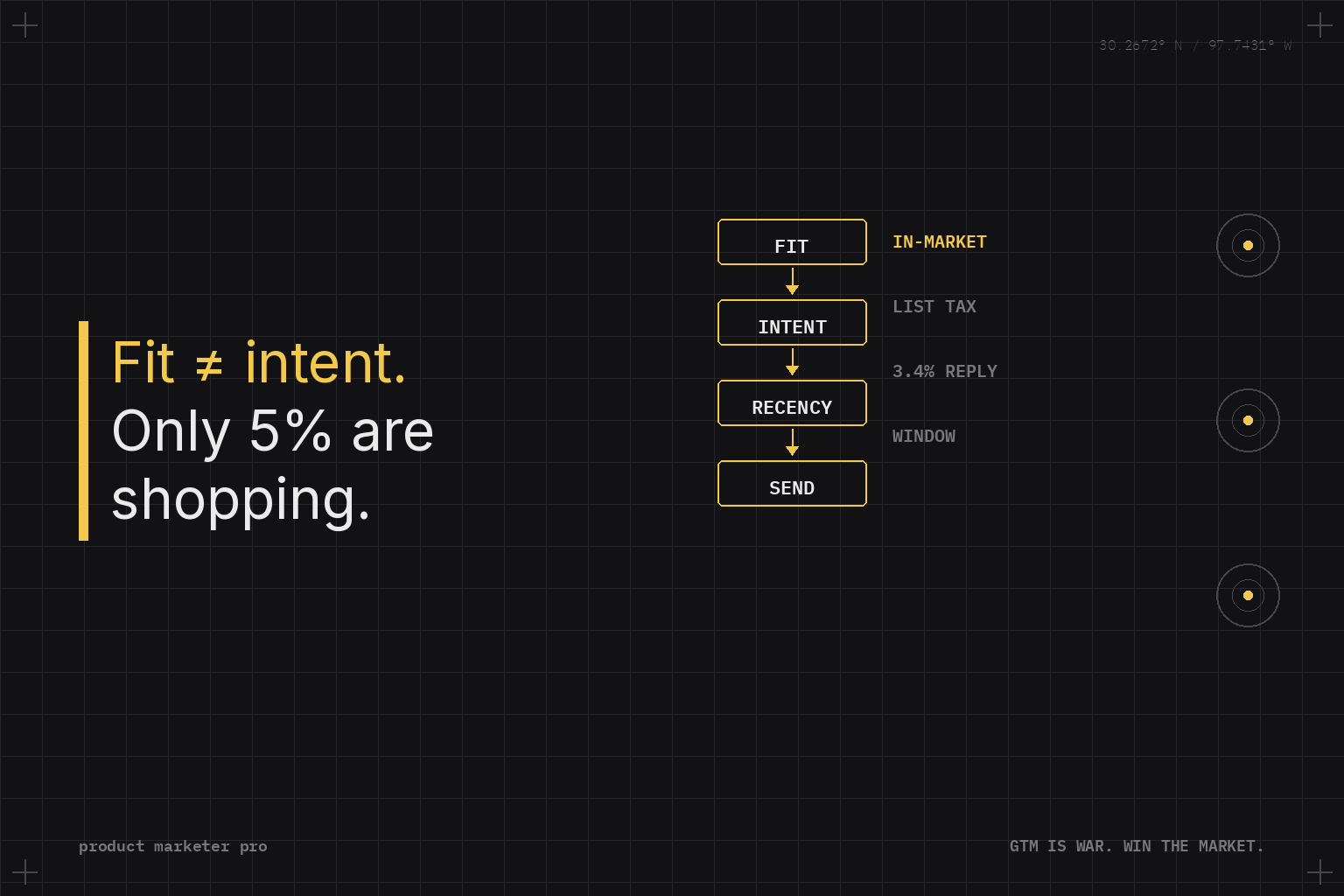
Ehrenberg-Bass and the LinkedIn B2B Institute: about 5% of B2B buyers are in-market at a time. Industry, headcount, and title put someone in your ICP. They do not put them in that 5%. Teams that only buy firmographic lists spray both piles and call it outbound.
Firmographic fit is not in-market proof. Teams that only buy size and title lists spray the 95% and pay Gong's 3.4% cold email reply tax.
What is firmographic fit?
Fit is the filter for who could buy.
Industry. Company size. Geo. Title. Tech stack if you sell into a stack. That is the who. It answers: would this account ever be a customer if they were shopping?
I use fit to keep junk out. I do not use fit to prove timing. A Series B SaaS with a VP Marketing in your sweet spot can still be out of market for eighteen months. LinkedIn will still show them as a perfect match.
If you swap the company name and the list still "works," you bought firmographics. You did not buy a buying window.
What is buyer intent?
Intent is proof they are shopping now.
Pricing page hits after de-anon (RB2B, Vector). G2 category or competitor traffic. Competitor LinkedIn engagement. Factors.ai paths that show the account bouncing across your site and a rival. PostHog product behavior that shows a team stuck on the problem you solve.
Intent is the sensor ping inside a buying window. Recency matters. A G2 visit last Tuesday beats a job change from six months ago with silence after.
Job change is a signal. It is not the motion. Fit plus a stale title change is still a cold list.
Why do teams confuse the two?
Because lists are easy and windows are work.
Vendors sell millions of "ICP matches." Dashboards light up. Sequences fill. Salesforce still says 27% of B2B reps hit quota. Busy boards do not equal booked meetings.
Gong, as cited: 3.4% cold email reply. 2.3% cold call to meeting. That is the floor when you treat firmographic lookalikes like in-market buyers. More seats on the dialer multiplies the tax. It does not invent desire.
By ignoring intent, you ignored why the spray board looked healthy and the calendar stayed empty.
How do I use both without spray?
Stack them. Do not collapse them.
- Firmographic fit first. Kill accounts that will never buy.
- Intent second. Keep only accounts leaking proof this week.
- Recency third. Old intent is folklore.
- Then enrich and write a first line that could only exist because you saw the signal.
Would you rather fifty accounts that hit pricing this week, or five thousand "perfect ICP" rows with no proof they care?
You need 7 sales, not 7,000 spray attempts.
AI can rank and draft inside that loop. Hand the model a firmographic-only list and you get Gong's floor at machine speed. Filter first. Model second.
What does this look like in practice?
Out of market, fit-only: nurture without demo spam. Brand, proof, category education for the 95%. Keep the desire visible. Do not pretend they are shopping.
In window, fit plus intent: move. Enrich fast. Offer a meeting, not a newsletter. Measure meetings booked from that list, not open rates.
Forrester puts the average B2B cycle at about 84 days once a deal is live. The window that opens the deal is shorter. Gartner: 30%+ of deals end in ghost or no-decision. Force-booking cold firmographic "interest" into that clock is how you grow the ghost pile.
This isn't a list-quality problem. This is an in-market problem.
Fit without intent is theater
ICP work still matters. The ICP is not a persona. Who buys, why it hurts, how the product creates the result. That is positioning rails.
But rails without a sensor are just a prettier spray list. Intent is the sensor. Fit is the fence.
Adapt or fail. The calendar is the scoreboard. The firmographic export is not.
FAQ
What is the difference between firmographic fit and buyer intent?
Fit is industry, size, title, and other traits that say an account could buy. Intent is proof they are shopping now. Fit without intent is a cold list that looks perfect on LinkedIn.
Can I outbound on firmographics alone?
You can. You will pay Gong's reply floor. Filter for intent and recency before you send if you want meetings, not theater.
Is a job change firmographic or intent?
It is a signal, not a full buying window. Pair it with fresh intent (pricing, G2, de-anon, competitor engagement) or treat it as a soft ping, not a demo ask.
What tools show buyer intent?
Examples only: RB2B or Vector for site de-anon, G2 for comparison traffic, Factors.ai for account paths, PostHog for product behavior, Clay for enrichment. None replace the fit + intent + recency filter.
How does this relate to the 95/5 rule?
About 5% of your ICP is in-market at a time. Firmographics describe the whole ICP. Intent finds the slice that will take a meeting this week.
Frequently asked questions
- What is the difference between firmographic fit and buyer intent?
- Fit is industry, size, title, and other traits that say an account could buy. Intent is proof they are shopping now. Fit without intent is a cold list that looks perfect on LinkedIn.
- Can I outbound on firmographics alone?
- You can. You will pay Gong's reply floor. Filter for intent and recency before you send if you want meetings, not theater.
- Is a job change firmographic or intent?
- It is a signal, not a full buying window. Pair it with fresh intent (pricing, G2, de-anon, competitor engagement) or treat it as a soft ping, not a demo ask.
- What tools show buyer intent?
- Examples only: RB2B or Vector for site de-anon, G2 for comparison traffic, Factors.ai for account paths, PostHog for product behavior, Clay for enrichment. None replace the fit + intent + recency filter.
- How does this relate to the 95/5 rule?
- About 5% of your ICP is in-market at a time. Firmographics describe the whole ICP. Intent finds the slice that will take a meeting this week.